There’s a sick irony about natural disasters that unfold during National Emergency Preparedness Week, but that’s exactly what’s happened in Canada for the past two years – at least. May 7-13 marks this year’s awareness campaign, as flood waters cause heartbreak in our eastern provinces.
I’m also thinking about the one-year anniversary of a disaster that was a real wake-up call for me. The wildfire that swept through Fort McMurray, Alberta last May challenged me to reassess what matters most in life, especially as a new parent. Even though I live three provinces east, in Ontario, news of the Fort McMurray evacuation was jolting.
I cried as I watched the footage. As the fire turned on the town, embers poured on a line of cars that crawled past blazing trees. I imagined the cars being driven by parents who were trying to keep calm for their kids. Many vehicles carried people who were forced to leave with nothing but the hope of reuniting with loved ones.
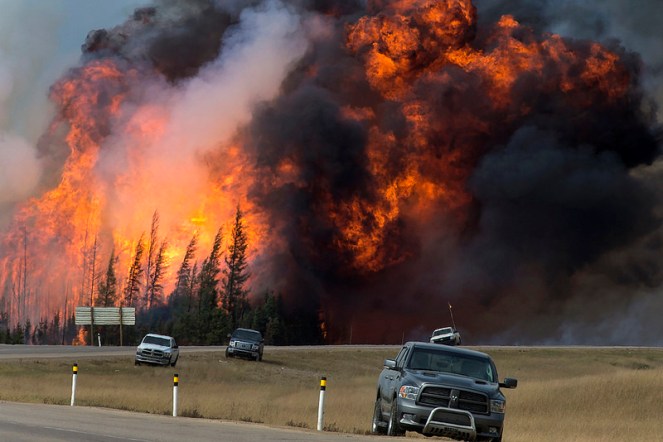 Photo credit: PremierofAlberta via Visual hunt / CC BY-ND
One evacuation story deeply resonated with me. A man who had minutes to evacuate his home retrieved just two items that he couldn’t bear to lose: his son’s first pair of baby shoes, and a box of mementos belonging to his own late mother.
I’m sure that, across Canada, people like me were asking themselves the same questions: What would I take if I had 5 minutes to evacuate? Do I even know where to find that right now?
In my mind, this man’s decision confirmed that when we’re about to lose everything we own, it’s only the sentimental items we can’t imagine leaving behind. They fill our hearts and shape our sense of identity like no other objects can.
Jey and I immediately donated to the Red Cross relief effort. Then we had a serious discussion. Although we’d already committed to the idea of owning less and living more (with our sights set on downsizing to a condo), we knew we still had to purge a lot of “stuff” that was literally getting in the way of our most treasured items.
Precious belongings like old letters and irreplaceable mementos—not to mention thousands of digital photos of Baby Ell—needed to be organized and made accessible, in case the worst happens – even if the worst we face here in Toronto is a sewage backup (and I sure fretted about this during the torrential rain we had last week!).
Our first step was dedicating time to sort through the mountain of boxes and computer files that had amassed over the years we’ve lived together. Sentimental physical items are now either photographed or scanned, and stored in a sensible place.
Although planning for an emergency should be a priority for everyone, I’m also motivated by the satisfaction that comes from knowing exactly where to find our most sentimental possessions. Jey and I acted on a 3-part strategy that serves both purposes:
We rent a safe-deposit box at the bank.
We use it to store photocopies of important government documents; a stack of old family letters; other irreplaceable sentimental documents, like poems Jey wrote for me (which we also scanned); and jump drives filled with document files, family photos/videos.
A safe-deposit box is also a good place to keep an inventory (with photos) of anything in your home that has value, for content-insurance purposes.
Note: safe-deposit boxes offer far more heat protection for jump drives, DVDs and electronics than the safes you can buy for your home (plus, banks have sprinkler systems). It’s also a good idea to back up files on the cloud, and to keep identical jump drives at a family member’s house.
We use a home safe that’s fireproof and waterproof.
This is the best place to keep original copies of government ID that you don’t need with you on a daily basis (i.e., passports, proof of social insurance, birth and marriage certificates), as well as insurance policies, a will, and the keys for a bank safe-deposit box. We now know to keep paperwork inside zippered plastic bags, because our marriage certificate was destroyed by mold inside our safe a few years ago – even though the safe was meant to be mold-resistant! Luckily it was replaceable.
This article gives a good rundown of what you should keep at home, although I disagree with point #4 (I’ve read multiple sources that warn electronics can melt inside a supposedly fireproof home safe that’s exposed to intense heat).
We each have a “Grab-and-Go Bag” for an evacuation scenario.
Google any variation of “Go Bag” or “evacuation kit”, and an endless number of government pages will appear. There’s likely a resource for the region you live in. Here in Toronto, the risk of a large-scale evacuation might feel small, but we’re not immune. And in the event of a house fire (say, one that starts in your neighbour’s unit), you can imagine how valuable it would be to have a bag at the ready if smoke detectors sounded.
The Canadian Red Cross sells its own Disaster Preparedness Kit – a fully stocked nylon backpack that has room left over for clothing and comfort items. And this page (with credit to the City of Greater Sudbury, Ontario) is a great resource for building your own bag. It’s a good idea to know the sentimental items that you’d absolutely want to take with you in an evacuation. Better yet, pre-pack these items if they aren’t typically on display at home – if they aren’t already in a bank safe-deposit box.
***
I realize that as the weather grows warmer and draws us outside, the idea of sorting through boxes indoors lacks appeal! I’m a fan of tackling this project in bites, doing one task nightly. The most encouraging thing I can say is, it’s a project that you’ll never regret spending time on. No time is wasted when you’re protecting what matters most.
 Life in Situ